Heads up
Cameras need filters too
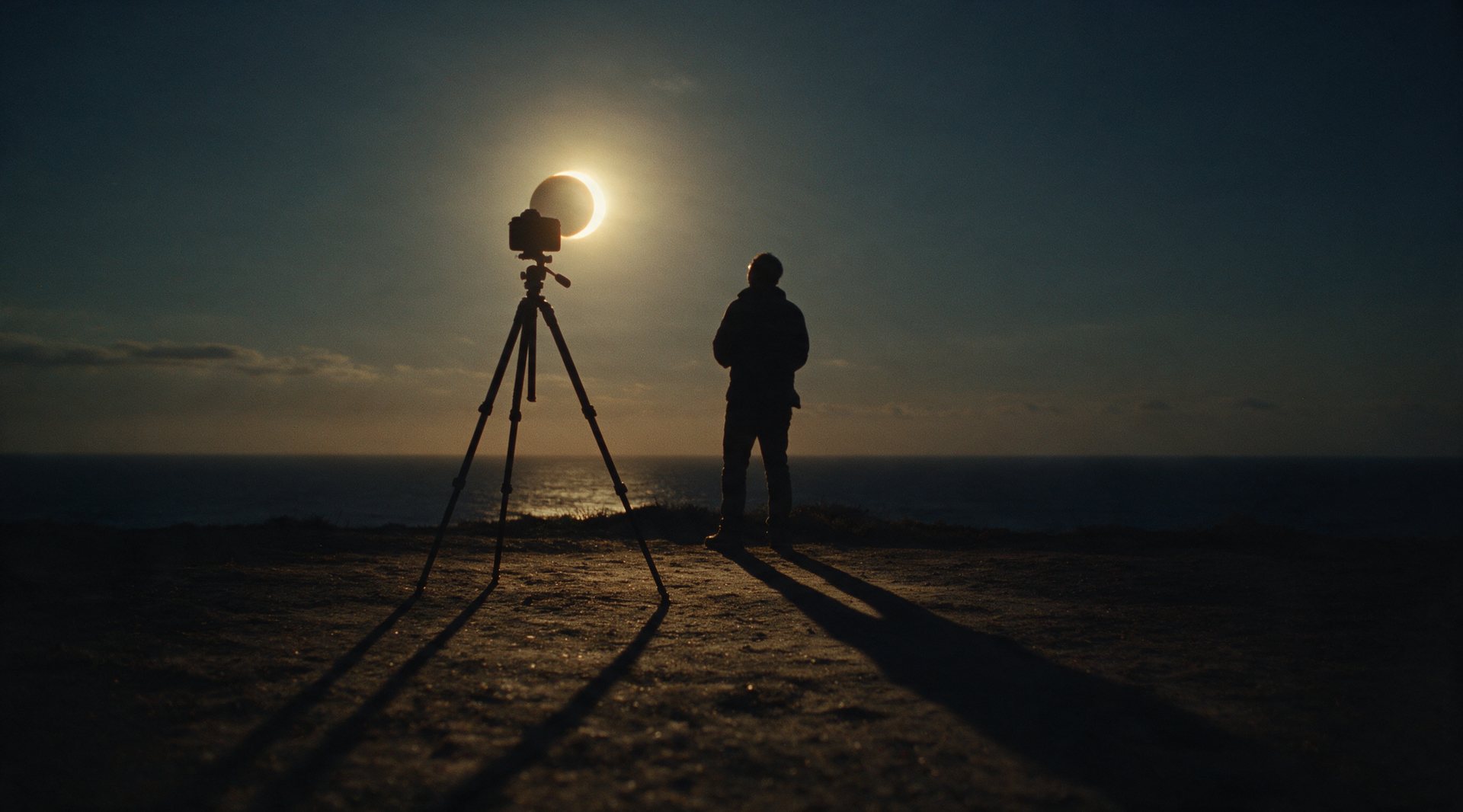
Pointing an unfiltered lens at the partial phases can destroy a camera sensor, and looking through an unfiltered optical viewfinder is worse than the naked eye. Purpose-made solar filters go on the front of the lens, and come off only for totality. Never improvise with eclipse glasses taped to optics.
What is actually worth shooting
- The scene, not the Sun. A phone cannot resolve the corona, but it does beautifully at what the big rigs miss: the crowd in half-light, the sunset ring around the horizon, faces at second contact. Those are the photographs you will keep.
- Crescent shadows through leaves, and any shadow-band ripples on pale ground: easy, safe, and stranger than any close-up.
- If you have a long lens and a solar filter, the partial phases and the diamond ring are the classic close-ups. They demand practice before the day, not on it.
The phone playbook
01 Set up before second contact
Pick your frame while there is still light: wide, horizon in shot, people in the foreground. Turn the flash off and leave it off.
02 Shoot video through totality
One take, started just before 10:45:33, catches the light collapsing, the crowd, and the dark. It films itself while you watch with your eyes.
03 Ignore the Sun itself
A tiny white blob in a dark sky is what phones produce, and chasing a better one costs you the event. Let the dedicated rigs have it.
If you bring real glass
A certified solar filter for the partial phases, filter off during totality only, exposure bracketing because the corona spans a huge brightness range, and a rehearsal of the filter-off-filter-on move until it is automatic: that is the discipline in one sentence. NASA and the AAS both publish detailed technique guides, and the serious ones agree on the last rule: whatever the camera is doing at second contact, look up.
Know what you will be pointing at.
The sequence of phenomena, from shadow bands to the chromosphere, in running order.
What we read
Everything above traces to one of these. Where a rule is set by a government rather than by us, go to the primary source before you travel — we check this page on a schedule, not continuously.
- Eye and equipment safety · American Astronomical Society
- NASA eclipse guides · NASA