The key point
The one rule of the sequence
Everything before and after totality needs eclipse glasses. Everything during it needs your bare eyes: the corona is about as bright as a full moon, and filters would simply hide it. Off at second contact, on at third.
The hour before
For a long while the eclipse is a secret between you and your glasses. Then, with most of the Sun covered, the world starts to give it away: daylight thins to something silvery and wrong, shadows go unnaturally sharp, and the gaps between tree leaves project hundreds of little crescent suns onto the ground. The temperature eases. Gulls and songbirds start behaving as if evening has come early.
In the last minute, watch pale ground and light-coloured walls: faint ripples of light and dark called shadow bands sometimes race across them, the atmosphere refracting the last sliver of sunlight. They are subtle, unphotographable, and one of the strangest things you will ever see.
The edge of darkness
01 Baily's beads
Seconds before totality the last sunlight breaks into separate beads along the Moon's edge, shining through lunar valleys. They wink out one by one.
02 The diamond ring
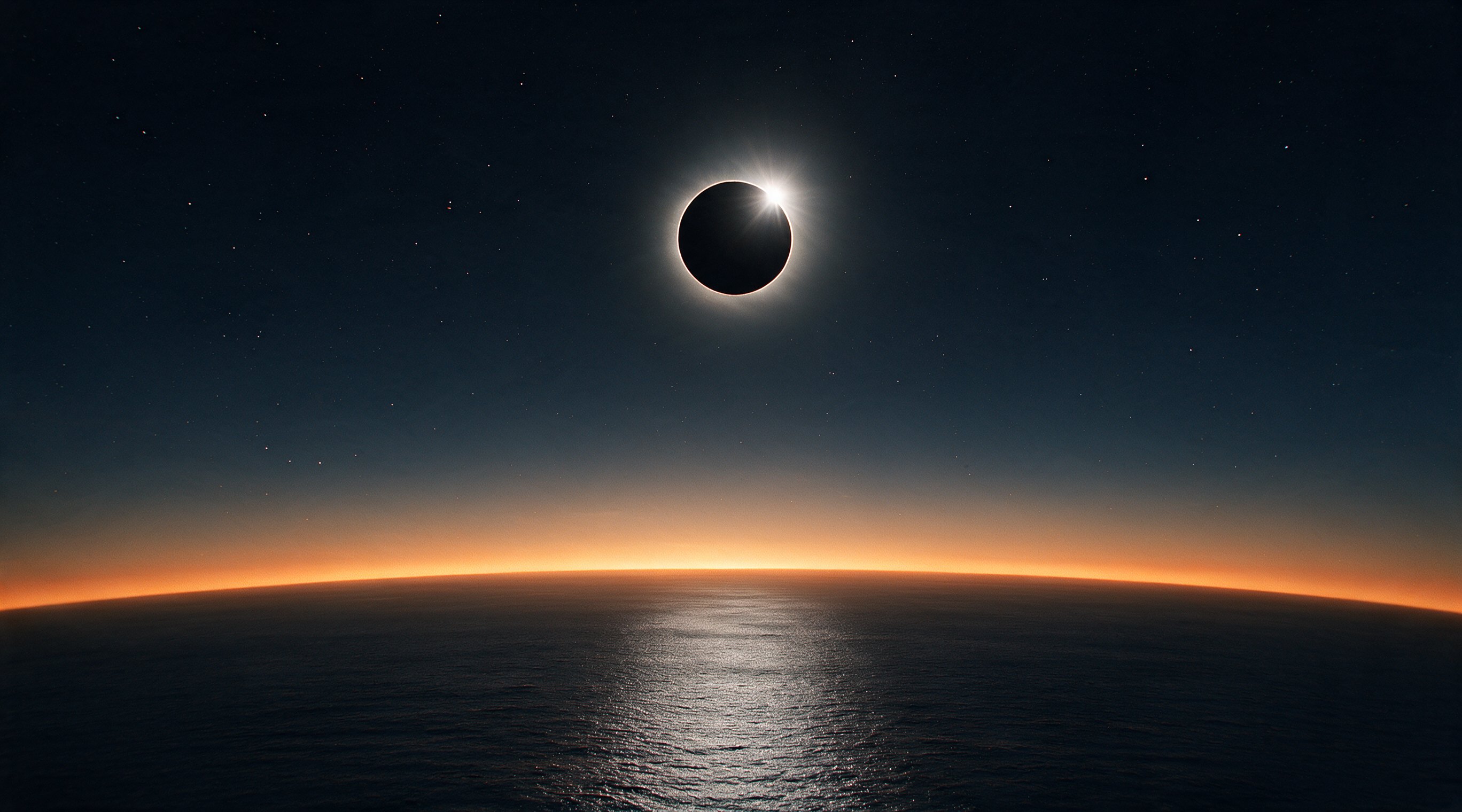
One bead outlasts the rest, blazing on the rim of the dark disc with the corona already showing behind it. This is the final instant filters are needed, and the image the day is remembered by.
03 Second contact
The bead breaks. Day switches off in a breath, and anyone still deciding where to look has already missed something.
Inside totality
The corona is the sight: the Sun's outer atmosphere, hotter than a million degrees, streaming pale and structured around the black circle of the Moon. No photograph carries its scale. Around the horizon, every direction at once wears sunset colours, because you are standing inside a shadow only a few hundred kilometres wide and the land beyond its edge is still in sunlight. Venus and the brighter stars appear. People cheer, then go quiet.
At the first and last seconds of totality, look for a thin red arc hugging the Moon's edge: the chromosphere, the layer of Sun between surface and corona, visible to the naked eye only in these moments.
The return
Third contact runs the sequence backwards at speed: the ring flashes on the opposite rim, light detonates back across the Strait, and within seconds the world is convincingly daytime again, glasses on, with an hour of departing partial phase that almost nobody watches. The four minutes are what you keep.
Note
Give the phenomena your eyes, not your phone
Every second spent framing a shot is a second of the rarest sky you will ever stand under. The photography guide makes the case properly, and shows what is genuinely worth capturing.
Know the sequence. Now pick the stage.
Europa Point for the arriving shadow, the Ridge for the全-horizon sunset, the marinas for comfort: the viewing guide compares them honestly.
What we read
Everything above traces to one of these. Where a rule is set by a government rather than by us, go to the primary source before you travel — we check this page on a schedule, not continuously.
- What happens at a total solar eclipse · timeanddate.com
- NASA eclipse guides · NASA