Places of worship
A cathedral on the site of the town's main mosque, a synagogue from 1724, a Hindu temple, a Franciscan chapel the garrison still uses, and a mosque a king paid for. Eight faiths' doors within a mile, no ticket at any of them.
Which door
Pick by what is open, not by the name.
Great Synagogue
The oldest
Engineer Lane, 1724
Best for The story of how the community began. Visits by arrangement only.
St Mary the Crowned
Open all day
Main Street, 07:00 to 19:00
Best for The one door you can count on, and the mosque beneath the plan.
Holy Trinity
The surprise
Cathedral Square, 11:00 to 15:00
Best for Horseshoe arches on an Anglican cathedral, by design.
Ibrahim-al-Ibrahim Mosque
Worth the bus
Europa Point, 11:00 to 15:00
Best for The southernmost mosque in Europe, open to visitors outside prayer.
The stops, north to south
Which doors open, when, and what is behind them. Hours are each congregation's own, checked 7 September 2026.
Photograph to come
01
The Great Synagogue and the other three
Behind a plain house front on Engineer Lane, the oldest congregation in the town.
In 1724 the Governor, Colonel Hargrave, gave a Jewish merchant, Isaac Netto, a plot on Engineer Lane; the shed Netto built there for prayers became Sha'ar Hashamayim, the Great Synagogue, at number 47 to 49, and he became the community's first religious leader. Three more followed as the community grew: the Little Synagogue at 91 Irish Town in 1789, Nefusot Yehuda at 65 Line Wall Road around 1800, and Abudarham at 119 Parliament Lane in 1820. All four are still in use and services rotate between them. None admits walk-in visitors: the doors are unmarked and locked outside services, and visits are arranged through the community, whose tours of Jewish Gibraltar, including the cemetery on the Rock, are advertised at the kosher bakery in town.
Where to eat
- Caffe Bottega 4.6 / 5
Parliament Lane is the next lane along; the Abudarham synagogue and the café share it.
On foot
Two minutes from Casemates: up Main Street and first left into Engineer Lane.
Bus
Route 5 from the frontier to Market Place, then two minutes on foot. £1.80, cash.
Taxi
Not worth it from anywhere in town.
Photograph to come
02
The Hindu Temple
A few doors down the same lane, and the newest of the eight.
Merchants from British India, mostly from around Hyderabad, began arriving in 1870 once the Suez Canal made the Rock a stop on the way east, and their descendants are the shopkeepers of Main Street. The temple on Engineer Lane was inaugurated on 1 March 2000 and serves a community of about 600. It opens on request rather than to a timetable: ring 200 42515 or write ahead and you will be shown in.
From the last stop
Stay on Engineer Lane; the temple is a short way along on the same side.
Photograph to come
03
Cathedral of St Mary the Crowned
The mosque under the plan.
This was the chief mosque of the Moorish town, and parts of that building survive in the fabric. It became a church soon after Castile took Gibraltar in 1462, was wrecked by four years of bombardment in the Great Siege of 1779 to 1783, and in the repairs Governor O'Hara had a quarter of its length cut off so Main Street could run straight past the door. The pink front and the courtyard are the result. Rome made it a cathedral in 1926. It is the one door on this walk you can rely on: open every day, Monday to Friday 07:00 to 19:00 and weekends 08:30 to 19:00, free, with Mass most mornings.
From the last stop
Back down Engineer Lane and right along Main Street; the cathedral is on the right at number 215, four minutes on.
Photograph to come
04
Cathedral of the Holy Trinity
An Anglican cathedral built to look Moorish, on purpose.
Begun in 1825 and finished in 1832 by the garrison's chief engineer, Colonel Pilkington, who chose horseshoe arches to mark the seven centuries of Moorish rule, so the town's newest church deliberately echoed its oldest. Queen Adelaide, William IV's widow, was at the consecration in 1838; it became a cathedral in 1842 and for a century was the seat of Anglican bishops for the whole of continental Europe. Open to visitors Monday to Saturday 11:00 to 15:00; Sunday services at 08:00 and 11:00, and Wednesday at 10:00.
From the last stop
Continue south on Main Street and turn right into Cathedral Square, three minutes.
Photograph to come
05
King's Chapel and the Convent
The first church built as a church, 1532, and still the garrison's.
Francisco de Madrid paid in 1531 for a chapel and an extension to the Franciscan friary that gives the Convent its name; the chapel was in use by 1532, the first purpose-built church on the Rock. The 1560 date by the door marks the bell tower rebuilt after Barbarossa's raid of 1540. Britain took the friary as the Governor's residence in 1704 and gave the chapel to the Church of England; a Spanish governor's wife is buried here from 1648, and British governors O'Hara and Campbell from 1802 and 1813. It is the Ministry of Defence's garrison chapel and opens to visitors Wednesday and Friday mornings, 09:30 to 13:00, or on request on 200 55414; an ecumenical service on the second Sunday of the month and an Anglican Eucharist on the fourth, both at 10:00, except in July and August.
From the last stop
Back to Main Street and south past the Convent's guard; the chapel door is beside it, two minutes.
Photograph to come
06
The Methodist church, and one that has closed
Wesley House, 297 Main Street.
Methodists have met on the Rock since 1769, among the soldiers first; the first chapel went up in 1809 on Prince Edward's Road and the congregation moved to 297 Main Street in 1956, rebuilding it as Wesley House. Visitors are welcome at services; times vary, so check the notice board or methodist.org.gi. Two minutes back up the hill on Governor's Parade is St Andrew's, the Church of Scotland's garrison church of 1854, which closed in December 2022. The building is still there; the door is not open.
From the last stop
South along Main Street, a minute past the chapel.
Photograph to come
07
Shrine of Our Lady of Europe
Europa Point: a mosque before 1309, a chapel since 1462.
The southernmost building on the Rock was a mosque before 1309 and was made a chapel in 1462. The two-foot painted wooden Virgin and Child installed in the fifteenth century is still here, having survived Barbarossa's sack of 1540; the light kept burning in the tower above it was Gibraltar's first lighthouse. Rome gave the shrine the Golden Rose, its highest award to a shrine, and 2009 marked seven hundred years of the devotion. There is a small museum of the shrine's history. Access is the honest problem: Visit Gibraltar lists it as not open to the public and the diocese publishes only Mass times, so ring 200 77138 before you make the trip. The mosque next door, by contrast, keeps visitor hours.
Bus
Route 2 from Market Place to the Europa Point terminus, every fifteen minutes; the shrine is two minutes from the stop. £1.80, cash.
On foot
About forty minutes from Grand Parade along Europa Road, all uphill, all pavement.
Taxi
Ten minutes from town; agree the fare first.
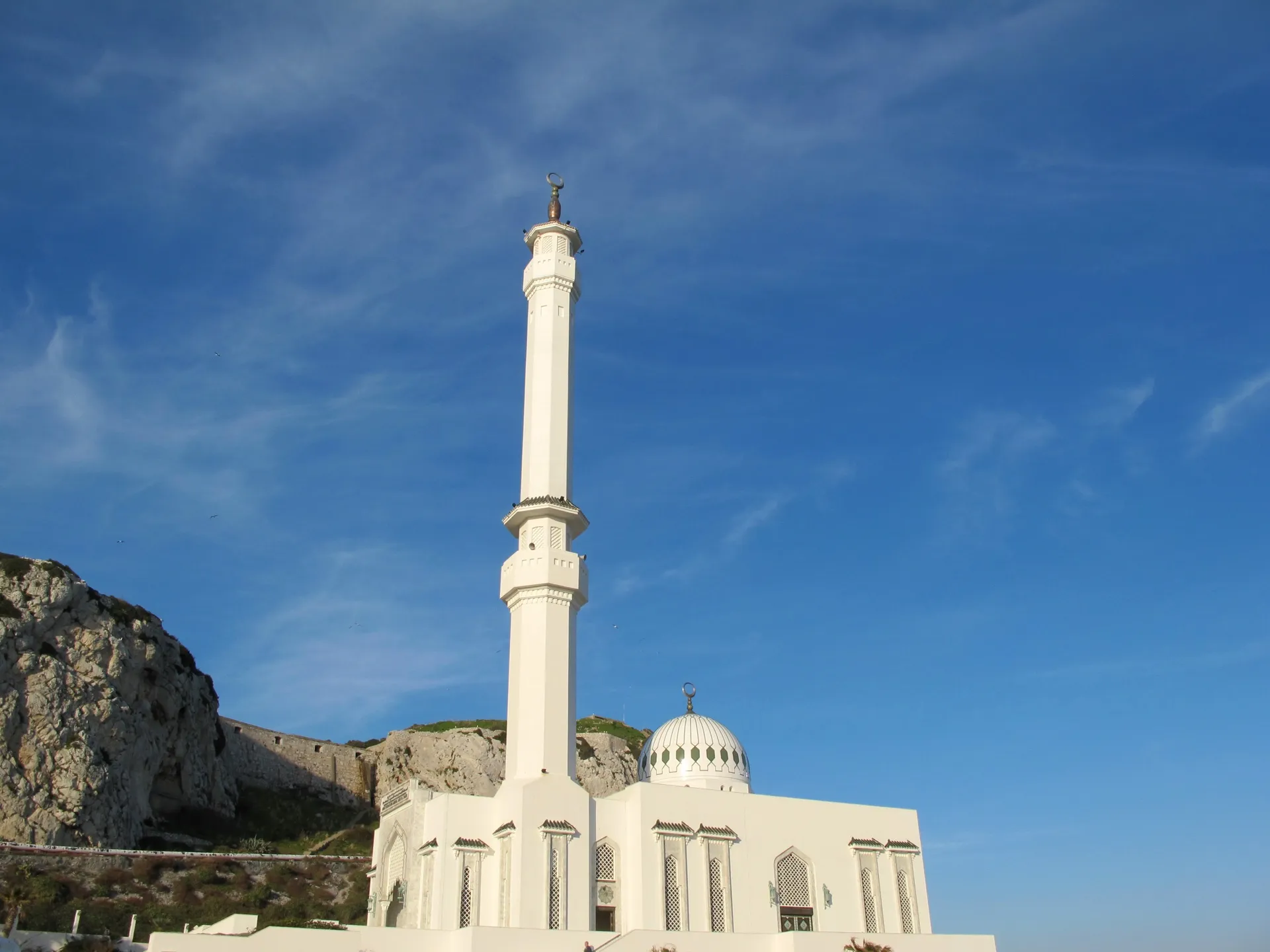
Photo: Acediscovery (CC BY 4.0)
08
Ibrahim-al-Ibrahim Mosque
A gift from a king, opened 8 July 1997.
King Fahd of Saudi Arabia paid for it, about five million pounds over two years, and it opened on 8 July 1997 with members of his family present. It is the southernmost mosque in Europe and one of the largest in any non-Muslim country: nine brass chandeliers inside, a 71-metre minaret outside, and Africa across the water. Non-Muslim visitors are welcome daily between 11:00 and 15:00 outside prayer times, free; cover shoulders and knees and leave shoes at the door.
From the last stop
Sixty yards along the point from the shrine.
Before you go
Not every door on this walk is open.
St Mary the Crowned, Holy Trinity, King's Chapel on its two mornings, and the mosque keep published visitor hours. The synagogues and the temple open by arrangement, and the shrine's public hours are not published. That is not a reason to skip them: the street fronts, the plaques and the lanes are the point of the walk, and a phone call the day before opens most of the rest.
Hours above are each congregation's own as published on 7 September 2026. They change with the season and the calendar of feasts. Visit Gibraltar, King's Chapel →
What we read
- Cathedral of St Mary the Crowned: mosque site, 1462, the Great Siege repairs, 1926; hours · Visit Gibraltar
- Cathedral of the Holy Trinity: visitor hours and services · Holy Trinity Cathedral
- Cathedral of the Holy Trinity: 1825 to 1832, Pilkington, 1838 consecration, 1842 · Wikipedia
- King's Chapel: 1532, the 1560 tower, burials, hours · Visit Gibraltar
- The Great Synagogue, 1724, Isaac Netto · Wikipedia
- The four synagogues, addresses and dates · Wikipedia
- Hindu Temple: 2000, the community, visits on request · Visit Gibraltar
- Gibraltar Methodist Church: 1769, 1809, Wesley House 1956 · Wikipedia
- St Andrew's Church: 1854, closed December 2022 · Wikipedia
- Shrine of Our Lady of Europe: history, museum, access · Visit Gibraltar
- Ibrahim-al-Ibrahim Mosque: 1997, cost, visitor hours · gibraltar.com
Spotted an error? We check every fact we can and date what we check, but hours, prices and owners change. If something here is wrong, tell us and we will fix it.